
This article was originally Published in The Scots Magazine, to whom we are very grateful to be allowed to reproduce - in HTML format. The copy was in Stuart Nisbet's possession and he kindly sent it to us. As I looked, a yellow mechanical arm rose up from the inside the castle walls like some giant claw from a science fiction film. It picked at the top of one of the walls and with a sudden jerk brought down some resisting masonry.
CATHCART CASTLE - Did it have to go? - Peter McDonald investigates
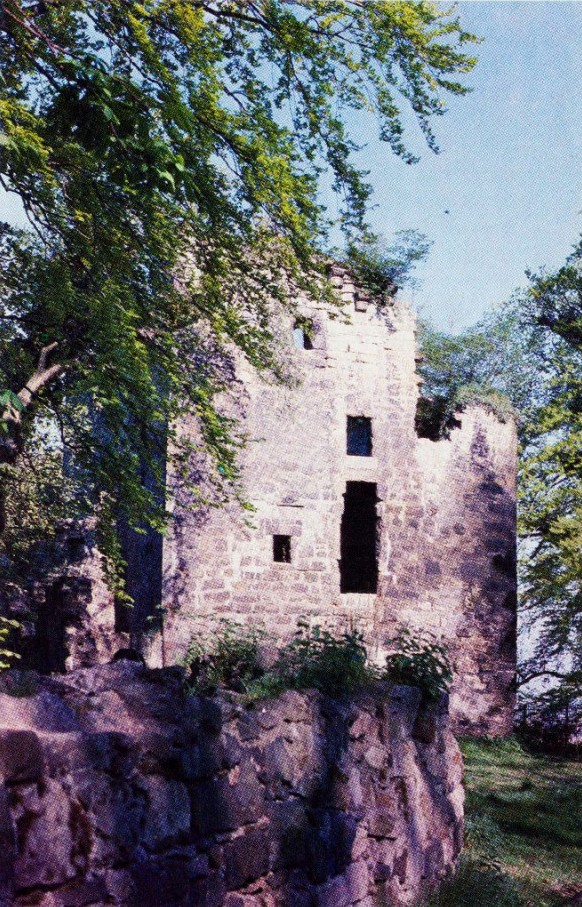 I was in the office of a Colleague when his phone rang. While he dealt with the call, I looked idly out of the window. It was a sunny August afternoon in 1980. My gaze happened to settle on Cathcart Castle about half a mile away. [An informed guess says he was in Scottish Power's building] As I looked, a yellow mechanical arm rose up from the inside the castle walls like some giant claw from a science fiction film. It picked at the top of one of the walls and with a sudden jerk brought down some resisting masonry.
I hadn't heard that anything was to happen to the castle. No-one had announced its possible demolition, no-one had formed an action committee to save it; I assumed that what I had seen was just in preparation for some repair work, and about time, too. Still, it seemed a funny way to go about repairing something, so I thought I would take a closer look when time permitted.
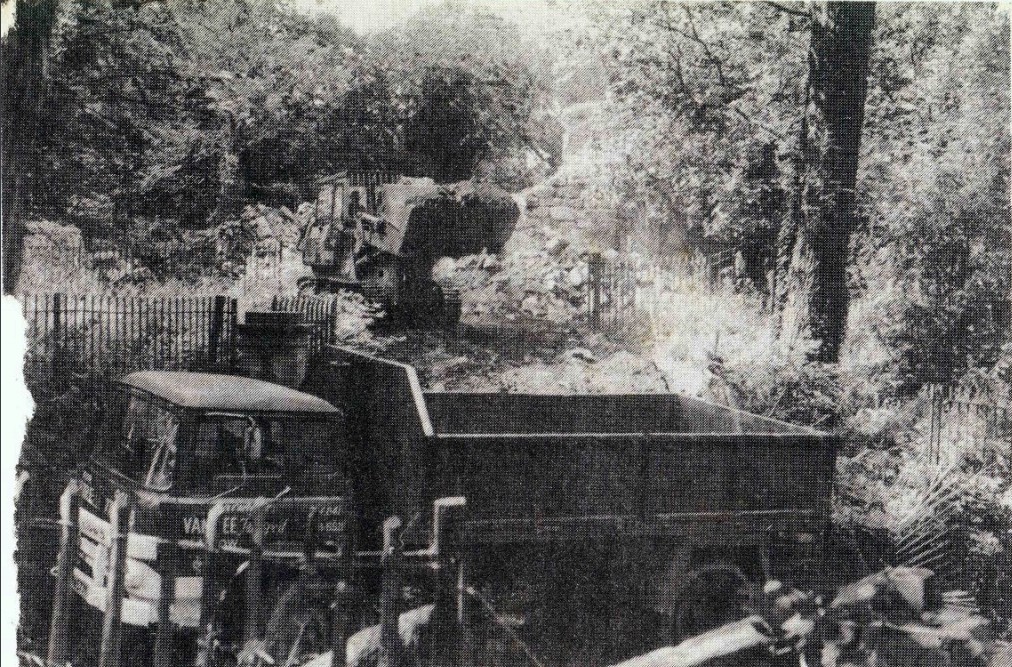
On my arrival at the site a couple of days later I was astonished to find workmen tipping the last of the stonework into lorries bound lor the former Queen's Dockwhere it was to be dumped as infill. Condemned, executed, and buried without ceremony, the 500 year old castle — one of only three left standing in Glasgow was now no more than a memory. How could it have happened ?
It has taken me some time to confirm what was fairly obvious from the start. A lack of maintenance over many years to an undistinguished extremely old and latterly ruinous structure had meant that it was onlv a matter of time before constant deterioration resulted in it being declared dangerous and brought down in the interests of public safety. There is no reason to suppose that in this respect the story of Cathcart Castle is very much different from that of many other venerable buildings which are quite literally being allowed to fall to pieces, so the story of its ultimate fall probably applies far beyond Glasgow.
Cathcart Castle as many will remember it. The writer took this picture [left] before the east wall collapsed at the end of 1979
The history of the 15th century castle was given in mv article, "The Castles of Glasgow" in The Scots Magazine of June 1979. The building was inhabited for about 300 years during which it was not involved in any event of great inierest except a legendary association with Mary, Queen of Scots at the time of her final defeat at the Battle of Langside in 1568. Abandoned around 1740, stripped of its roof and left to decay, it was eventually acquired in 1928 by Glasgow Corporation as part of Linn Park. Although given periodic attention over the vears there was nothing ofl lasting benefit, and in December 1979 heavy rain caused the east wall to collapse. After that, the deterioration of the remaining walls meant that it posed an increasing risk to the public so it was decided to render them safe by lowering.
Unfortunately it seems that as the loose upper parts were removed, the lower courses were weakened so that they, too, had to go. This process repeated itself until there was virtually nothing left.
That was the story as I had gathered it from newspaper reports, local gossip and a few inquiries. It seems that the local community council and the Cathcart Socictv had done what they could to save ihe casile and had said some hard words about its loss. To get a view from ihe inside. I spoke to Mr Andrew MacKenzie. Chief Architect of ihe Civic Design Section in Glasgow District Council's Department ot Architecture.
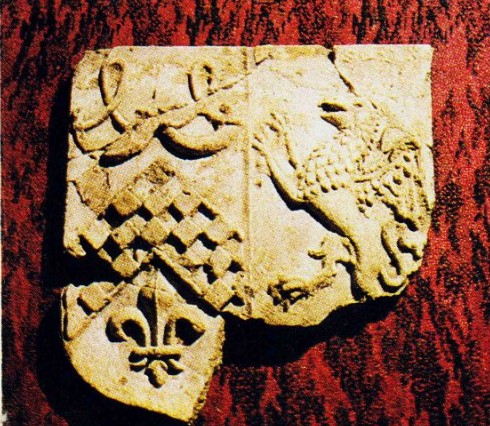 Photograph left of the plaster shield uncovered during excavations after Ihe castle was demolished It is dated around 1627.He had known the castle from boyhood, but had first inspected it in a professional capacity only about ten vears ago.
"It was obviously in a very poor condition. Trees were growing out of the top. The walls had had water running through them for over 150 years, and the filling between ihe inner and outer facings was just like wet sand. There was DO strength in it at all." he told me.
"Some people think that jerry-building was invented this century. It's simply not true. This castle was not well built. Just because a building has stood for a long time does not mean it is sound."
I said I thought that sounded a bit contradictory.
"No. It's like a lot of these very old buildings. They are thought of by our own generation to be great, but everything is built to a cost." The castle had stood for 500 years, I persisted. Mr MacKenzie smiled.
"Anything which survives over 100 years becomes interesting, over 150 years it is ripe for preservation. But is it usable as a building?" He became less defensive as he warmed to his subject. "So long as a building is required for a purpose, it will be used and maintained accordingly.
When that use is no longer required or when another building can do it better or more cheaply, ii is led 10 deteriorate. That's what happened to Cathcart Casile over 200 years ago. Some buildings survive in poor conditions for a long time."
I was slill a bit sceptical, perhaps, because I didn't want to hear what I was being told. Changing tack, I asked it he was saying that it was beyond repair.
" No, it would not have been physically impossible to do repairs, but it would have needed a considerable amount of money to do it properly — in the order of a hundred or even hundreds, of thousands of pounds. The interior fill of the walls was just sand and small stones, too small even for the standards of the day. It was just a sandy mush — that's why the contractors had to pull it to the ground."
I found the amount of money involved, surprising.
"Well, it sounds a lot, but you see you would have needed a team of skilled men to take it down piece by piece and rebuild it. Remember I said the fill between the walls was just a mush, so it wouldn't have been simply a matter of pointing ihc walls. In any case, I think some parts would have had to come down anyway. Remember that removing walls by hand involves erecting scaffolding and the possibility of some element of danger to the men doing ihe work, maybe in bad weather, especially if the walls are unstable."
It all sounded depressingly final. The castle didn't seem to have had a chance and I asked Mr MacKenzie if he considered whether earlier maintenance would have made any difference.
" It's difficult to say. There were inspections and reports done over the years since the Corporation took it over in 1928. but it had been a ruin lor almost 200 years by then. A report in 1950 said its condition was very poor with danger of the walls bursting from invasion by vegetation, tree roots and vandals. So although it might have cost less to save it then than now. it was still more than anyone was willing to spend and that's what matters at the end of the day."
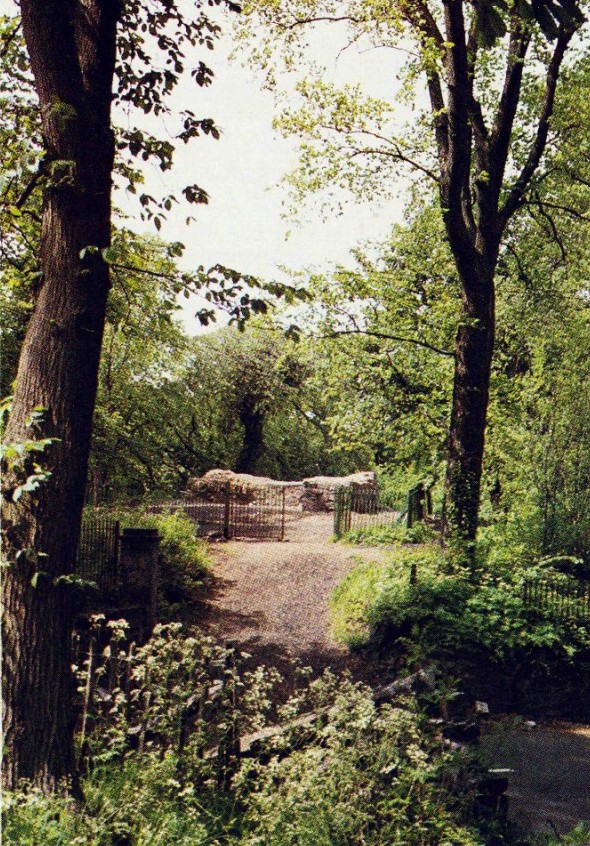 The site today. Little remains to indicate that a castle stood here for 500 years. Photograph to the right.
Knowing Glasgow's oft-recited problems of urban decay, I realised that with one of Europe's biggest post-war slum clearance programmes in Front of it, the Corporation in the 1950's were not likely to have had much spare cash for preserving an old ruin. Yet it was one of the city's oldest surviving buildings. Did that not entitle it to special treatment? Mr MacKenzie paused briefly then watched for my reaction as he continued.
" As an official all I can do is advise. I can report on a situation, I can propose a solution, I can recommend a course of action, but I don't take the decision about spending money. That's done by the elected representatives, and they are elected by you and me and all the other ratepayers. If the ratepayers want their money spent on preserving old castles instead of building new houses or schools, they must tell their councillors."
A very diplomatic reply, but it left me feeling even more as if the official attitude was one of resignation if not actual indifference. Did Mr MacKenzic not have any personal regrets about the loss of the castle?
"Oh, yes, but you have to be realistic. As well as being an architect, I am also a life-member of the National Trust for Scotland, so I am very interested in our heritage. But the NTS is struggling hard enough to maintain the properties it has. It won't take on any more buildings, even as gifts, unless they are accompanied by enough money to cover maintenance costs."
As if to emphasise the point, the NTS announced in April this year that they had been able to take over Hill House, the Helensburgh mansion designed bv Charles Rennie Mackintosh, only because it was accompanied by an endowment of £425,000 (which, they hoped, public subscription would raise to £500,000). Most of the income from the fund would be used for maintenance.
"You can reckon on spending something in the nature of five to ten per cent of the capital value of older buildings annually on maintenance," Mr MacKenzie told me. " Everything has its life. To prolong that life costs money. In this country we have more old buildings than we can afford to maintain. Unless you take a decision to maintain them at all costs, some will have to go; and as I said earlier, it is difficult to justify maintaining a building for which there is no use.
"You must also remember that so far as Cathcart Castle was concerned, the Parks Department's prime concern is not with buildings. Even so, they had started restoring the snuff mill next to the castle until the cut-backs stopped the work."
In my article on Glasgow's castles I had mentioned that particular restoration and had suggested that the castle might be next. That sueeestion evoked a response from notrestoration and had suggested that the castle might be next. That suggestion evoked a response from the British Trust for Conservation Volunteers who wrote to me proposing that it might be a project in which they could get involved. I referred them to the District Council, but obviously the proposal came to nothing.
As Mr MacKenzie and I talked on, it became clear to me that Cathcart was only one example of a very big problem, but a problem of Which the public was not really aware. Of course, it would be wrong to insist on preserving every old building. Change, decay, death, new life—these are natural processes which we must acknowledge and accept. It is the business of deciding what is worth preserving that is difficult, and it is not helped by present efforts to restrict the growth of public expenditure. Without expressing views on the correctness of such a policy, it is a fact that in the short-term it has practical effects on Conservation.
Certainly, whether or not Government policy was a factor, when the District Council applied in 1980 for grant aid or guardianship for Cathcart Castle, they were told by the Ancient Monument Inspectorate of the Scottish Development Department that the remains were not of sufficient merit to warrant either. Crookston Castle is under the guardianship of the Secretary of State for Scotland and as a result is in a much healthier state than Cathcart, although I noticed in May this year that Castle Sween in Knapdale, also in guardianship, had to be closed to the public because it was becoming dangerous. " That's another aspect of conservation which costs money," observed Mr MacKenzie. " If you have a ruin, you must take steps to avoid abuse. So it is necessary to have attendants who will control visitors. There is an attendant at Crookston, but Cathcart was simply fenced around."
I wondered how many other buildings in Glasgow were under threat.
" More than you might imagine, some of them well known; and it's not just in Glasgow. As I say, someone has to take a decision about which stay and which go. You might well find, for instance, that the money needed for Cathcart was used for another building like the People's Palace Winter Gardens. As you know, they and now the Palace itself need a great deal of money spent to do proper repairs."
Was it not possible to keep things going until more money became available?
"Spreading the money thinly over a large number is no good. Patching-up only delays the problem, and can make it worse. You see, apart from weathering, water penetration, dry rot and so on—all of ihem going on while maintenance or repairs are delayed — you can lose your skilled craftsmen if there is no work for them. You may have to pay off squads that have taken years to build up and train to the standards necessary. Even putting them on other work means that they lose their skills, or go elsewhere. It's difficult to attract new men because payment today is based on results measured in quantity not quality. So good work doesn't pay. You need dedicated men. Using outside contractors isn't always the answer, because the practice of accepting ihe lowest lender means that you are never sure you are getting the best, only the cheapest."
We had spent considerably longer on the interview than either of us had intended. It was an indication of Mr MacKenzie's concern, and I left feeling differently about local authorities and about our supposedly enlightened, conservation-minded age. It no longer seemed that the authorities were either complacent or indifferent merely powerless.
This Feeling of frustration about the apparent attitude of officialdom is widely felt, however. One person who gave expression to it in public was Dave Pollock, Chairman of the Urban Archaeology Support Group, who wrote to a national newspaper earlier this year. Since the appearance of thai letter, though not connected with it, Glasgow District Council have announced a campaign to encourage the use of vacant or under-used buildings of merit, precisely to prevent them falling into dereliction. Even before that announcement, I had learned that one sucli building, the vacant Scotland Street School by Charles Rennie Mackintosh, had been saved by a decision to use it as a Museum of Education and another, a former church, had been converted into a restaurant and night club.
However, Mr Pollock's main point was that the remains of the old town were being neglected in such a way that archaeological excavation would soon become impossible or pointless. He claimed that £0.75m. was being spent annually, excavating in London. By contrast, "excavation in the centre of Glasgow last year ran on a Youth Opportunities Scheme and a grant of £50 from the Glasgow Archaeological Society. But for the support of the staff in the People's Palace this would have been inadequate for one excavation, much less the two completed."
The group that Mr Pollock represents comprises a number of individuals interested as professionals and amateurs in urban archaeology, especially in Glasgow. They have carried out about half a dozen digs in the city, including one on the site of Cathcart Castle.
 Excavations in progress at the western end of the Cathcart Castle site, under the leadership of archaeologist Brian Kerr [Photograph left]
I missed the open day they held to let the public see their work at the castle site, but one holiday Monday last year I went over to take some photographs and was surprised to find the site fully manned. In charge was Brian Kerr, a qualified archaeologist. Assisting Brian was a handful of unemployed youngsters on a Youth Opportunities project. A notice on the gate explained the background to the dig, funded partly by a grant from the District Council's Museums Department. Additional funds depended on a tin for donations attached to the gale.
Brian showed me round with great enthusiasm and a good deal more understanding of what was around us than I could absorb. I have to admit that one hole looks much like another to me, but Brian patiently pointed out where the layers in trenches showed how earlier foundations had been used for later walls and how the bottom of one trench reached the original base of what appeared to have been a defensive ditch about 15 feet deep, probably crossed by some form of draw-bridge. The defensive system of the castle, which stood on a rocky promontory above the River Cart, was stronger than they expected compared with other tower-houses of the time. A great deal of effort had been used to make the ditch because it had been hewn out of whinstone. Just removing stones, soil and rubbish to the same depth had been enough lor the team.
In the north-west corner was a deep pit whose purpose could not be explained. If it had been a well, it would have had to be over 60 feet deep to reach water level. If not, the use was not explained by anything dug out of it, although they never reached the bottom. There was evidence of later buildings on the site of the abandoned castle and until the beginning of this century there had been inhabited dwellings on or around the castle. Indeed, they had almost certainly used some of the castle stone in their building.
To me as a layman the most dramatic find was a plaster shield which, though broken, was almost complete. Brian later showed it to me saying that it has been dated at around 1627. I wondered how he had come to this conclusion since it bears no writing.
"Documentary evidence," he replied. What did that mean?
"Charters," he said tersely, but with a grin.
I invited him to expand.
"We know that the arms are those of Semple and Lauder. Those on the left are of Bryce Semple of Cathcart; on the right those of Jean Lauder of Halton, now called Hatton, near Edinburgh. We also know from a charter granted in May 1627 that the couple were at that time in Renfrewshire — Craigbait Castle if you want to be absolutely precise. By June they were in possession at Cathcart, so the shield probably dates from shortly after then."
I was duly impressed.
 How Cathcart Castle might have looked in its heyday - an artist's impression by Dave Pollock.
"You might like to see this, too," Brian suggested, holding a pencil sketch of the castle. "It's an imaginative reconstruction of how the castle might have looked in its heyday. Dave Pollock drew it. I'm not sure that I agree with every detail, but it's probably a fair impression of how it appeared. Dramatic, isn't it?"
I agreed, and mentioned I had seen Dave Pollock's letter. How was the group doing? " Well, we were at the Briggait for a while and now we've started at St James Road near the Royal Infirmary," replied Brian. "That's the northern limit of the mediaeval town and also the site of the proposed east flank of the inner ring road. That poses a threat to a lot of interesting sites."
I wondered how their financial state was, remembering the donations box.
"We get our money mainly from the Government under the YOP scheme. The group try to encourage public support for our work and look for private sponsors and so on. We even publish our own magazine, Glasdig. I'm sorry I can't give you one, we sold out all 400 of the first edition."
As my name was put down for a copy of the second edition, I asked about what was happening in this field elsewhere in Scotland. " There are two Government-sponsored digs at the moment," Brian told me, " one in St Andrews and the other in Perth. Perth is a good site . . . good preservation."
Undaunted by present problems, he looked forward to more excavations, more teams. A move from one-off projects to a more permanently established arrangement was a long-term hope, but Brian was anxious not to appear critical or ungrateful for the support they had received so far.
 What of the future of the Cathcart Castle site? At the time of writing the remaining pans of the walls are being tidied up and the area around it is being landscaped. There might be some sort of explanatory notice. I don't imagine that the notice would explain the paradox of a country which declines to spend money on preserving monuments, but considers it worthwhile to make a gesture once they fall down. Neither, I presume, would the notice make reference to the debate about priorities which is, or ought to be, going on among those involved in the conservation of our heritage. It would mark the end of what may simply have been a lucky survivor living on borrowed time.
It might have the distinction of marking the beginning of a more active and informed public debate on the future of our past.
How it all ended It was August 1980 and the rubble was being loaded into demolition lorries for removal to the Queen's Dock
Photographs by Peter McDonald
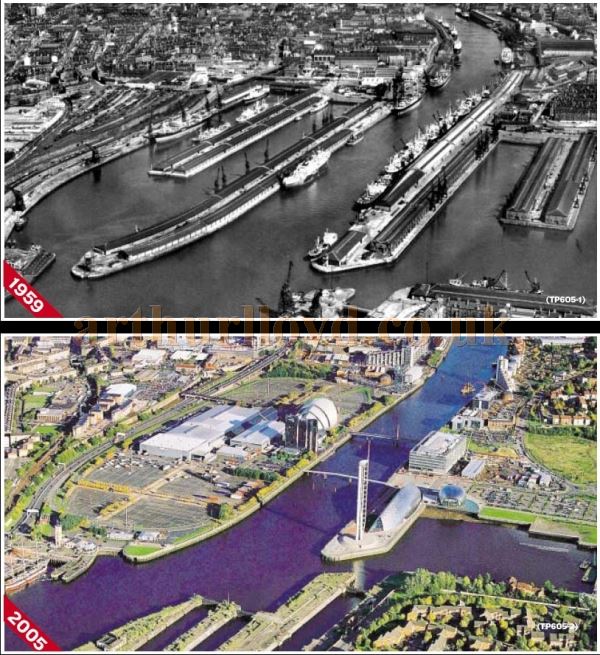 Note by Dave Campbell: Queens dock was filled in to build the SECC on so the blocks are lost forever. St.Enochs hotel ended up in there as well.
This photograph is from arthurlloyd.co.uk.