
The 18th Century improvements to the lands forming the park saw the start of the industrialisation and mineral extraction activities, and the building of new houses: Cartside House (sometimes called Cathcart House) being one example.
The article reviews the four lands forming the park - Castlemains, Goldenlee, Hagtonhill, and Bogton.
Castlemains
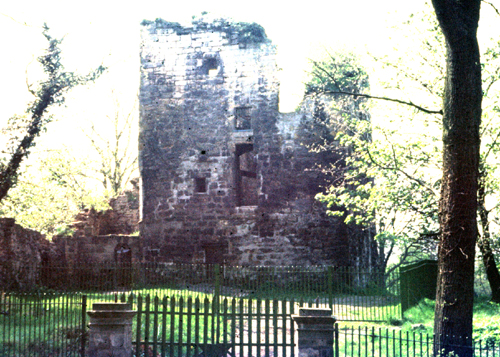 Although Castlemains included Cathcart Castle, our interest is mainly in the Castle’s decline during the buildup of Linn Park, not its medieval owners or brief royal visitors. The castle remains date from the mid-fifteenth century.
A century later it was acquired by the Semples of Ladymuir, who took the title Semple of Cathcart, although the traditional Cathcart family later re-acquired it. Early documents refer to the ‘castle, fortalice, mills, woods, and coaleries’, a hint at the mix of features which make up Linn Park.
The castle was four stories high, with three upper floors sitting on a vaulted basement. The surviving remains show that it was rectangular in plan and enclosed by a curtain wall. [For more on the castle click here].
Much attention has been paid to Court Knowe, the hill overlooking the Castle, as the alleged position from where Queen Mary viewed the battle of Langside. A carved stone (predating the present granite monument) stood in the grounds of Cartside House, before being removed to Kelvingrove Museum in the 1920s. Whatever the truth, castles have a habit of moving site, and Court Knowe is perhaps more interesting from its name, hinting that it was the location of the local baron court. In the 1770s the owners, the Maxwells of Williamwood, still held local courts on their estate, which alternated between Cathcart, Netherlee and Busby. At these gatherings they collected rents and settled disputes. Court Knowe may in fact have been the site of the original castle, on a motte surrounded by a ringwork, the remains of which were noted in 1974. It is often said that the Castlemains owner, Maxwell of Williamwood, was last to reside in the castle in the 1750s. In fact he rented it out to tenants, including John Leggat in the 1760s.
The largest mansion in what became Linn Park was not Linn House, but Cartside House (sometimes called Cathcart House). Cartside was built in the shadow of the castle in the eighteenth century by James Hill, who also laid out the riverside ground below his mansion as a bleachfield. In 1765-6 adverts appeared for:
Ten acres of Castlemains, lying on the south side of the Castle, with a convenient new house (Cartside), well exposed to the sun and sheltered from storms, with five rooms, kitchen and stable.
Goldenlee
By 1720 Maxwell of Williamwood owned most of Cathcart parish, from Cathcart to Busby, including Goldenlee. When it changed hands in 1761 Goldenlee consisted of:
The lower orchard, yards, dovecot and houses, with three tenants, George Sark, Robert Young and John Watson, including 3 acres called the Walkers land, with the waulk mill possessed by John Ralph.
The Maxwells were very ambitious and carried out extensive improvements to their lands, exploited minerals and encouraged the development of mills. Like the other main players in Linn’s development, they saw the potential of cultivating sugar in the Caribbean. Three of Maxwell of Williamwood’s sons ventured to the Caribbean, however all died or were simply recorded in family papers as ‘lost’ in the West Indies.
Hagtonhill
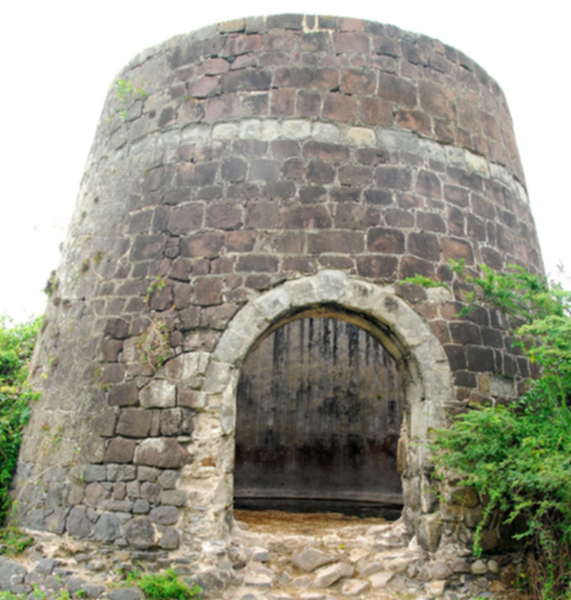 The bulk of Linn Park is on Hagtonhill land. In 1766 the five merk land of Hagtonhill was advertised as part of the lands and Barony of Aikenhead. It included coal and limestone quarries, and the mill and lands of Linn. It was purchased by one of Glasgow’s leading mercantile families, the McDowalls of Castle Semple. The McDowalls improved and enclosed the land and exploited its mineral resources. The family’s wealth came from personal ownership of sugar plantations in the Caribbean. The first William McDowall built up plantations on St Kitts from 1710. His son William expanded to Grenada and during his ownership of Hagtonhill, was MP for Glasgow and Renfrewshire. His brother James McDowall was provost of Glasgow. Through 1791-2 the 130 acre grass farm of Hagtonhill was to let, including:
A freestone quarry, lime craig and plenty of coal, plus 9 acres of Lyn of Cathcart with its houses, yards & waulkmill and Linn House, a ‘commodious house on the banks of the Cart’.
The McDowalls laid out and enclosed the lands. Their belts of planting did not necessarily coincide with later planting and remnants of old boundaries can be found in Linn Park’s woodland.
Bogton
As we saw, the Maxwells of Williamwood descended from the Bogton Maxwells, who played an important part in the development of the parkland. In the 1660s the youngest Maxwell son got the portion including the entry to Linn Park from Netherlee. Sometime between the 1750’s and the 1790’s, farming improvements moved the Bogton tenants to four farmsteads.
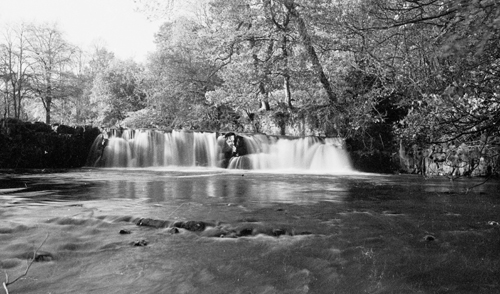 The main Bogton settlement (Mickle or Mains of Bogton) remained at Muirend, with a smaller settlement (Little Bogton) to the west. High Bogton, was at the summit of Netherlee Road, in what is now the cemetery. There was a further Bogton settlement on the Braehead or Holmhead portion of Bogton. The part at the entry to what became Linn Park passed to James Hall, who married one of the Maxwell daughters. In 1792 James Hall of Bogton bought Linn, uniting both sides of the Cart around Linn falls. However Linn would not become a true estate until a bridge was built across the river. From 1793 adverts appeared for:
Parts of Hagtonhill and Bogton called the Linn Park, where there is a fall of about sixteen feet called the Linn, which is easily improved. Included was the lease of the house at Linn. Also at Linn was a good free stone quarry, a lime craig and plenty of coal.
Previous Section: Linn Park’s Lands
Next Section: 19th Century: The build up of a country estate.