
Solomon Lindsay, born in 1722, came to Cathcart from Penicuik in 1812 and began the manufacture of paper in what had been a meal mill at the side of the Old Bridge. Two years later he introduced a new feature, the manufacture of snuff which occupied only a small part of the building.
Glasgow was past the throes of the tobacco trade with America when manufacturers sent their leaf to Lindsay's to be ground into snuff. Cardboard used in bookbinding, however, was chiefly produced here at the mill.
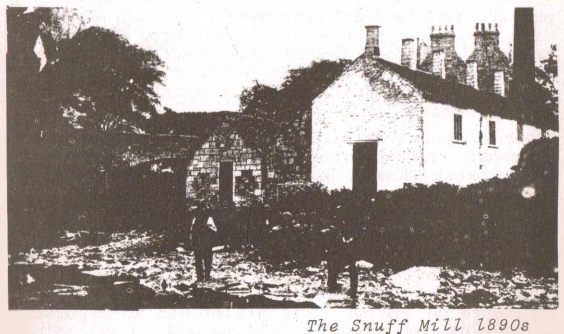 After his death in 1859, his son David Lindsay carried on the business until 1902 when he died in the same room in which he had been born 85 years previously [see Note 1]. His cottage was where Mill House now stands at the entrance to the Linn Park. At one time he thought of marriage and was given permission by the Earl of Cathcart to build a house for his bride-to-be. Lindsay House was erected in 1863.
His lordship, however, was extremely annoyed at the large house in old baronial style instead of the cottage he had expected. David Lindsay never did wed, and soon flitted back to his "ain wee hoose". Above the door of the former main entrance to Lindsay House can be seen a perfect monogram, all the letters of the name "Lindsay" being entwined. It later became one of the
tenements the old gentleman also very possibly deplored. (It may never have occurred to him that he too altered the landscape in building this house, in design so different from the rest).
With the owner's death, the mill closed and the stock was sold, bringing to an end Cathcart Paper Mill, known in the trade as "No 19". Three years later the Earl sold the cottage and mills to the later Mr McIntosh who took down the cottage and built on its site the villa "Mill House". Since the recent death of Miss McIntosh, the last member of this family, the name of the house has been removed.
The ancient mill is in use temporarily as private lock-ups at the moment. Though at one time three water-wheels existed, none is now to be seen. The part of the old snuff mill which stands at the river's edge bears the date 1858 but that part adjoining the road is the really ancient section.
When stocks were cleared, souvenir containers of snuff were distributed among local residents. There is at least one left after all these years.
CATHCART MILL
As is well known, every district long ago had its meal mill to which the farmers sent their A grain to be ground. The miller was an important member of the community and usually a man of substance. Two stones lying side by side in the old churchyard mark the graves of generations of Halls who were the millers of Cathcart. For record purposes only, on one stone is the following:
"Here lyes the dust of John Hall of Cathcart
Mill, and of Ellison Craig, his wife, AD 1689;
likewise of John Hall in Cathcart Mill aged 80
who died AD 1743; and of Helen Gilmour, his
wife 1773".
On the other stone:
"Here lies
interred the body of James Hall of Cathcart Mill
who departed this life December 14, 1782, in the
57th year of his age and is the burial place
appointed for his wife and their children".
However, no further names have been added (See next chapter) .
LANGSIDE MEAL MILL
The mill was erected before the end of the 16th Century at the foot of Millbrae, at the west corner of the road at what is now Tantallon Road. A small cottage still stands a short distance from the foot of the brae looking down on Millbrae Bridge. This was the miller's house and the mill occupied the ground in front of it.
Millbrae derived its name from this, in all probability. The inlet of the lade was upriver at the bend near Carmichael Place, and the outlet a short distance below the b.ridge. There used also to be a high wooden fence from the Bluebell Wood to Millbrae Road" so close to the river that it only left a narrow lane instead of today's broad Tantallon Road. The millers here were the Uries and afterwards the Craigs. The mill was destroyed by fire in 1852, now only the cottage remains. Perhaps some day there will be some interesting excavations here?
[?? Modern Map reqd]