
About 1660 paper was first manufactured in Scotland and towards the end of 1685 a French refugee driven from his country by religious intolerance arrived at Greenock with his daughter Elise, then about six or seven years old. Friends there encouraged him to further his business of paper-making in the West of Scotland and so he made his way to Glasgow.
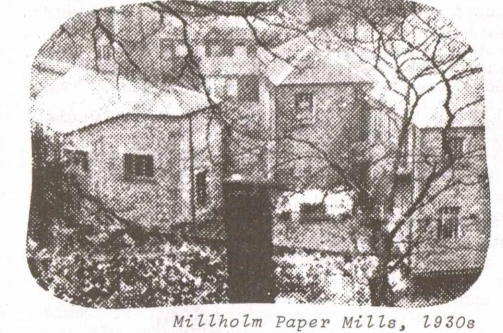
Nicholas Deschamp collected rags and in time set up the paper mill by the side of the River Cart, known afterwards as Paper Mill Farm (at the end of Earlspark Avenue, beside Langside Station). He called on the "guidwives" of farmers and cottars, and astonished them by saying in his broken English that, however soiled and worthless the rags were, he would "buy dem all and make dem ver good for lily vite paper". Business continued to prosper and in 1729 or soon after, he moved to larger premises at Millholm on the south side of the river not far from Cathcart Castle.
Each of the paper mills, it will be noticed, was situated beside a weir since a plentiful supply of pure water was necessary for good writing paper or cardboard. Millholm was certainly an ideal spot. The buildings were almost hidden from view by the trees with only the chimney stack visible (demolished March 18th, 1938). The spoil was used for the Empire Exhibition at Bellahouston.
Elise Deschamp married the meal miller's son James Hall who was apprenticed to her father and who afterwards inherited the business. He died in 1759 and, so far as we know, the paper mill continued in the family until the beginning of the 19th Century. Generations of Halls are buried in the old churchyard and confusion reigns between the Halls who were millers and those who were paper-makers. It is suggested that the old Frenchman changed his name to Hall but there is nothing to prove or disprove this. No doubt he lies in the parish churchyard.
 According to church records, only by publicly appearing before the congregation and renouncing both the pope and the Devil was he accepted as a member of the Church of Scotland. During his sojourn in Cathcart he had been a regular church-goer and enjoyed a certain measure of respect as a businessman, yet, with true Scots canniness, the people were also suspicious of him. In 1696 he subscribed £100 to the Darien Scheme and supplied the paper used by the Darien Company. At that time he made no effort to change his name. Elise Deschamp, after her marriage, was known by the diminutive· "Peggy" .
Millholm, it is believed, was in the hands of Hall's trustees until sold to Messrs R & J Couper in 1853 who had been tenants since 1841. During these years paper had been made by hand but in 1853 the Couper Brothers introduced machinery. Known as Mill No.18, the Couper Mills manufactured paper for writing purposes used by banks and lawyers. Large orders were also placed by the Government.
Robert Couper was joined in the ventures by his brother James, a local carpenter. They were men of principle and held in high esteem. About £8,000 was left by Mr Robert Couper to build a hall, reading room and library for Cathcart. He also left a sum of money called the "Couper Bequest" for the benefit of local people in dire need, the only condition being that they reside within a mile of Cathcart. Miss Marion Couper, the last of the family, died in 1933 aged 84. It was she who launched a scheme.to start the Victoria Infirmary as she was disturbed at the lack of hospital facilities on the south side of the Clyde. The "Victoria" was eventually opened in 1890 by His Grace the Duke of Argyll and dedicated by the Rt Rev James Smith, D.D., of Cathcart Parish Church. Yes, Cathcart has had good reason to be grateful to the Couper family.
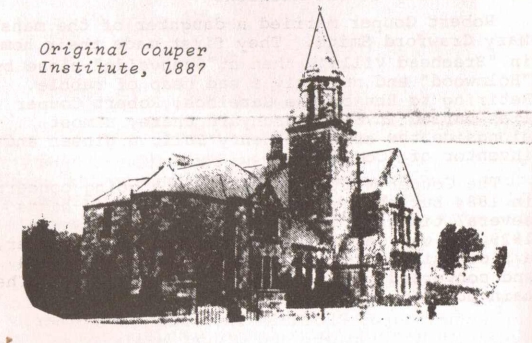 At the time of the annexation to Glasgow in 1912, the Corporation decided to make alterations to the Couper Institute to meet the reqUirements of an increasing population, but owing to World War I this was not completed until 1923. The Lord Provost, Sir Thomas Paxton, Bt., L.L.D., opened the halls on April 18th. The Chairman and Convener of the Halls Committee, Councillor George D. Morton, announced that the original estimate for the work had been approximately £20,000 but now, after the war, it was in the region of £40,000 - so even then costs were escalating to a surprising-degree.
The original Couper Institute remains with the name and date 1887 inscribed in front. The architect was James Sellars, who also designed the Victoria Infirmary. The Library, a most excellent one, was built on the one side and the large hall on the other.
James Couper lived in "Holmwood", close to the mill. This house is a splendid example of "Greek"Thomson architecture and was built in 1859. Several well-known business gentlemen have been the owners, one of them being Bailie James Gray, J.P., who Closely resembled the late Lloyd George. When the Liberal leader visited him in the 1920s, Cathcart was en fete for the occasion.
Since 1959, "Holmwood" has been the convent of "Our Lady of the Missions".
Robert Couper married a daughter of the manse, Mary Crawford Smith. They first made their home in "Braehead Villa", then at"Sunnyside" close by "Holmwood" and now only a sad heap of rubble. Retiring to Rhu on the Gareloch, Robert Couper lies buried in the churchyard there, almost alongside the grave of Henry Bell, engineer and inventor of "Comet" fame.
The Couper Mills were sold as a going concern in 1884 but throughout the years changed hands several times. The older mill closed down in 1929 and was demolished in 1938 while the other, a flock mill, was bought by Macfarlanes in 1947 and converted to a civil engineering plant. The main building was gutted by fire in 1953.