
The Cathcart District RaILway was opened from the city to Mount Florida in 1886. In May of that year the line was extended to Cathcart and the Circle was finally completed in 1894.
The station was at first on the north side of the river and this became the goods depot when the station moved to its present position. Three entrances were planned and the "entry that never was" is now a kiosk underneath the railway bridge in Clarkston Road. The old Cathcart and Fordneuk Roads disappeared in the redevelopment of this part to make way for the station's two entrances.
Running the "Cathcarts" was apparently a complicated business according to one signalman who declared it to be the best train service in Glasgow, timed to the minute. If a certain big-wig wanted to say it took a man with a good head to run a main-line station, "then it took a man wi' twa' heids tae run the Cathcarts!" This was, of course, in the early days. Later unaccountable delays at Mount Florida and probably due to the cauld blasts often felt there earned the station there the name of Mount Misery. But all that belongs to the past.
British Railways took over on January 1st, 1948, and introduced the Blue Trains.with their new design of coaches a few years ago. The circle was electrified by 1962 [see Note 1] and the name curtailed to British Rail.
Today's trains may be brighter, cleaner and faster, but the old steam engine held a certain amount of romance and character. Daily commuters had a choice between 1st or 3rd Class compartments and chose pre-arranged parts of the train to meet. Woe betide the casual who strayed into the unofficially-reserved carriage and spoiled the card game or the chatter! With little cash to spend during the week in those teenage days, full use was often made of the season tickets in the evenings. Cupid may have shot a few darts but of violence or vandalism there was none. The "Puggy" as it was less politely termed (presumably from the pug type engines) will never be the same again.
The station was built amidst green fields and pasture land. To Mount Florida Station the view was uninterrupted, and looking in an easterly direction the only building was the toll house at the corner of Carmunnock and Malsmire Roads. To the north was Cathcart Free Church, better known as Battlefield East, while beside it was Crichton's House "Aitkenlea" and on the hill above "Eildon Villas".
 There were also villas on Langside Hill with no other buildings in between. When the River Cart overflowed its banks the flooded fields were a reminder of the meaning of the word "Holm" (as in Holmhead, Holmlea, etc) meaning level low ground on banks of a river". In the l890s serious flooding occurred at "Aitkenlea", causing heavy losses in poultry and cattle. About five years ago the River Cart overflowed to Holmlea Road by the bus depot, this same piece of ground once called "Aitkenlea".
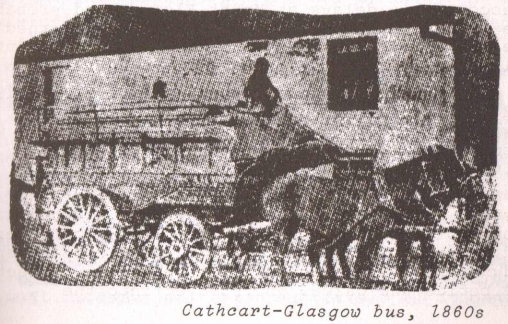
Before the advent of the railway, Peter Craig's two buses ran for many years from Gow's public house in Clarkston Road to the city from 8 a.m. until 6 p.m. on weekdays, the last homeward journey being at 7 p.m. It was said that they I were good comfortable vehicles drawn by two well-fed horses.
The Tramway and Omnibus Company ran horse and mule drawn cars, and the laying of rails in Glasgow streets began in the 1870s. The Corporation continued with horse-drawn vehicles. until the turn of the century, but Cathcart never saw this type of tram since it got no further than Mount Florida which was then the city boundary. A depot was built and Holmlea Road constructed in 1900-01 especially for the electric trams, the first of which appeared on September 13th, 1902.
For many years trams were known by their colour and number. White No. 19 trams plied between Cathcart and Springburn termini, and yellow No.5 between Kirklee and Netherlee or Clarkston. The routes diverged at Garry Street and the fares varied from ½d to 2½d. The service was second to none, and the city's farewell in 1962 will be remembered for some time to come. All models of trams are exhibited- in the excellent Transport Museum at Pollokshields.
Motorbus services started in Glasgow in 1924, followed by trolley buses ("silent death") in 1949. The wires for the latter disfigured the roads with unsightly poles and overhead wires but were soon removed in favour of the present diesel vehicles.
The "troubles of the country" are again apparent, and the city's transport department has to cope with an acute shortage of staff as well as high running costs. Some new system of public transport is clearly required, but what .....?