
Why Cathcart
All about Cathcart by
Jean Marshall 1969
Published by [Vista Logo] VISTA STUDIOS, GLASGOW, 534 Sauehiehall Street, Glasgow C.2.
Glasgow is divided into thirty-seven wards - and Cathcart is No 37. Each year in April a public meeting of electors is held in the Couper Institute, which all residents should attend. Public notices inform date and time - yet how many avail themselves of this opportunity.
A committee is elected, consisting of 36 members whose name must be on the Register of Electors for the division of the Ward for which they are elected and they must be residents therein. For election of the committee, Cathcart Ward is divided into three diVision, West, Central and South, each represented by 12 members one third of whom retire in rotation annually. They meet to discuss district matters, usually with one Ward Councillor present.
Member of Parliament for Cathcart at present is Mr Edward Taylor, M.A., a most energetic and hardworking young man. He has made known his constituency at Westminster and elsewhere as never before. The only time that Cathcart was represented by a Labour MP was back in 1922 when Captain Hay took his seat in the House. It was remarked at the time that Mr Hay was the only MP representing a Scottish constituency which had a Welsh name - but the identity of the knowledgeable one is not disclosed.
Prior to passing of the Representation of the People Act in 1918, Cathcart Ward, a part of the City of Glasgow from 1912, was still included in the Renfrewshire Eastern Constituency. Our first MP in 1918 was John William Pratt, followed 1n 1922 by Captain John Primrose Hay; in 1923 Robert McDonald; 1929 John Train D.L.,J.P.; 1942 Francis Beattie, D.L., J,P.; 1946 John Henderson, D.L., J.P.; and in 1964 by Edward Taylor, M.A.
Names and addresses of the MP, Councillors and Ward Secretary can always be found in the Couper Institute Library. As the Register of Electors includes many surrounding districts within the Cathcart Ward and numbers 39,000, it is difficult to estimate now the population of Cathcart proper.
And so, from tiny hamlet or clachan, Cathcart has grown. It combines the very old, typified by the Castle, with modern and efficient industry. Unlike new towns and housing estates, its rich history in a handsome setting contrasts harmoniously with houses presenting many varied degrees of affluence. Let us hope that good planning, with local pride at heart, prevails in meeting the challenge of the future. If these pages have helped to preserve a little,of what has gone before, then something has been achieved.
In conclusion
This community began by the river over a thousand years ago.
Soon the "Fort on the Cart" may be no more. All things pass, the river flows steadily on.....
0, scenes of my childhood and dear
to my heart
Those happy years I've known in
Cathcart.
Jean (Liddle) Marshall
It is only fair to say that no inside information has been sought or gained regarding any local firm, and that this chapter relates only to items thought to be of general interest.
Towards the end of last century, apart from the paper mills, Geddes Dye-Works and Carpet Factory offered the main employment to Cathcart. This firm, along with the Creamery and several smaller firms, were concentrated on the ground now occupied by the tenements of Holmhead Crescent, Holmhead Place, Holmhead Park, etc.
This centre of industry was flanked by the workers' cottages each having their own little plot of ground, and very attractive it must have looked, particularly alongside the River Cart. Mr John Geddes built "Thornbank", the self-contained and latterly derelict house at the corner of Clarkston Road and Monreith Road East, now a block of luxury flats. His brother William resided in "Holmhead House" at the top of Rhannan Road.
In 1886, when the Geddes works were on the way out, Weir's works'were very much on the way in. Marine engineer consultants, George and James Weir, restricted by the manufacturers of their various patents, opened a small factory here in Cathcart. The success of this venture was due mainly to the inventive genius of James Weir. During the 1914-18 war, in addition to marine and naval work, the factory made shells and gun carriages, also aero fuselages and engine cylinder blocks. In the 20s and 30s the company expanded, acquiring firms in Glasgow and London engaged on similar work.
During the early 1930s a strange-looking machine - the Auto-girb - was seen flying around and on this Weir's carried out development and research work, later progressing to helicopters. Without doubt James G. Weir was a key figure in helicopter flight. To perpetuate his name Strathclyde University have named their Montrose Street extension the James Weir Building.
This same gentleman had the distinction of being the great-great-grandson of Robert Burns.
G & J Weir have made a world-wide name for themselves in marine, power-station, oil industry and condensing plant, and thus brought Cathcart to the knowledge of men in every quarter of the globe.
In the last war in addition to marine, naval and industrial work, Weir's were also engaged in producing the carriage and recoil system of the famous 25lb field gun. Now in addition to its main products the firm makes sea-water distilling plant and high-pressure compressors.
For many years Weir's timely horn was followed later by the shrill notes from Wallace Scott's Tailoring Institute. To look at, this building represented one's idea of the model factory in a garden. Its architect was J.J. Burnett, afterwards Sir James Burnett, who became one of the best known architects of his time. Now the area is the property of the South of Scotland Electricity Board and we watch:and await the changes taking place.
While the Depression of the 1930s had an adverse effect on heavy engineering, the Macfarlane Engineering Company in Netherlee Road fared better than others by pioneering and developing specialised electrical work in arc welding and laboratory plant. Set up in 1911 by five brothers, it is still very much a family concern. The former chairman, Mr James C. Macfarlane (who died in 1967 aged 91), designed and manufactured (not in Cathcart) the generator used by Marconi to send the first wireless signal across the Atlantic from Poldhu in Cornwall and was himself present at the historic event. The present chairman, Dr James W. Macfarlane is County Convener of Renfrewshire.
In Glasgow's parks the entertainers once held sway, and concert parties and military or works bands visited regularly each week. Admission charges were moderate but more people listened outwith the enclosure than inside - consequently Music in the Parks became a losing proposition. The Linn Park bandstand has been removed and in its place is housed the Children's Zoo.
Whether imagination or not, we no longer seem to have those long balmy evenings for sitting out of doors for any length of time. An occasional act or artist comes to mind, and one clearly remembers Arthur Askey, the comedian known for his catch phrase - "I thang you!" On confirming this with Mr Askey, he replied that his first two years of 'Showbiz' were spent touring the parks of Glasgow. He recalls in particular Kelvingrove and the University clock booming every quarter just as he cracked his best gags! (Dare it be mentioned that that was in the late 1920s?)
With television and transistors, today's sophisticated youngsters would have little time for pierrots or band concerts unless accompanied by the magic of the 'beat group'. Television has changed the habits of many. The popularity of the cinema has declined and where we in Cathcart had a choice of half a dozen picture houses, all within reasonable distance - The George; Kingsway, Mayfair, Florida, State and Toledo - only the Mayfair and Toledo remain, and at the time of writing the fate of the latter hangs in the balance. Before the 'Cathcart Bowl' opened in 1965 the building had been the local cinema. It closed during July and August because good weather kept away'the patrons!
(Those summers must have been better) .
In the days of silent films the Cathcart Picture House could boast its own orchestra - Willie Wilson's 6-piece Band. In a recent conversation with Mrs Archibald Cameron (Nan Hetherton that was) she told of how, as relief pianist, she played suitable music for ha1f-an-hour each evening and also at the Saturday matinee. She then had to dash over to the Waverley Cinema. Shawlands, to repeat the performance there. As no buses served this route she had to walk every night in hail, rain or shine. An accomplished pianist, for all this she received the princely sum of ten shillings per week - and had to supply her own music. One manager would tell her in no uncertain manner, when her selection was becoming stale!
Talkies arrived and after alterations the Cathcart P.H. was renamed the Rialto and later the George. Now,it is a five-pin Bowling Centre and the Kingsway has changed to a Bingo Hall. Lantern lectures, Band of Hope soirees, kinder-spiels (no, not Princess Chrysanthemum again, please!) - all these belong to a by-gone era although church youth organisations are ever to the fore, working hard to help the young in group activities.
The Holm1ea Tennis Courts and Bowling Greens are not so crowded any more. With the successes in the tennis world of Clarkston young lady, Miss Winnie Shaw, a revival in inter-city or even inter-district championships might have been hoped for; but perhaps some day .....?
One spot always well patronised is the 'Swing Park' which gives continued enjoyment and healthy exercise. Do kiddies still have the measure of the watchman? One 'watchie' you knew to obey instantly, while another could be ignored for a little time but then had to be obeyed or else ....
This ground was gifted by Sir John Stirling Maxwell in 1914, the Corporation providing the recreational facilities. The bowling greens were added later. Cathcart Private Bowling Club dates from 1889 and a curious feature emerges in that the neighbouring greens all opened at intervals of ten years: Newlands in 1899, Mount Florida in 1909, Weir's Recreation Club 1919, Kingswood 1929.
Reverting to the differences between then and now, we were lucky to have so much space to play and roam within sight of our homes. Spare ground on either side of the 'Swings' provided lots of room for ball games without fear of broken windows or damage to passers-by or property. At the foot of Tulloch Street a storage yard of sorts was known locally as the 'barricades' and could have been classed as an adventure playground if the phrase had then existed - we only knew it as a good place for climbing.
The back park (ahint Holmlea Road) was full of dens and hides until such spoil-sports as Gilbert Austin Ltd (now Anderson & King), the Civil Defence and others moved in. Boys tended then to group together as now, one street challenging another, but it was a friendly rivalry by comparison and no bad blood was spilled. Deteriorating back-courts, cramped garden space and roads clogged with private cars, leave little room today to release children's unbounding energy.
It is a happy change, however, to see the observance of such events as Christmas, even if over commercialised. The number of windows brightly lit with trees of varying sizes in homes of varying sizes, never fail to surprise and delight. It is also a happy change that the 'fever van' which we recognised as distinct from the ambulance and 'Belvedere', are words no longer on the lips of the young. Here, perhaps, is the cue to remember the few so necessary and important in every community - our doctors.
For close on 60 years Dr R. Murray-Lyon regularly made his calls, first by pony and trap and then by car, always seated beside his chauffeur Dingwall so much a part of the Cathcart scene. The Doctor's rather stern and forbidding appearance made many a young patient quail but not for long. Underneath that grim exterior lay a very kindly and compassionate gentleman. His son, Dr David, continues as faithfully to attend successive generations. Not for nothing the Murray-Lyons have been tabbed 'the Deliverers of Cathcart'. The untimely death of Dr Bremner was a sad blow. Meanwhile Dr Hay and Dr Hutchison carry on the good work in the footsteps of those medicos of yesteryear, Doctors Jack, Gray and McKinnon.
The Clean Air Act of 1956 resulted in this area becoming a smokeless zone by 1966. Great are the possibilities of this smoke free city of the future.
When Cathcart was absorbed by Glasgow, the local police strength was increased by one sergeant - viewed at the time with mixed feeling, this being a very law-abiding district. 'Old Hughie' and 'Jokey Simpson' were kenspeckle figures long before 'John Bull' and 'Swanky Joe'. No ordinary beat cops these, they were an institution. Apart from the points-duty policeman recently ousted from his position by traffic lights, we no longer know our 'bobbies'.
Familiar faces together with the joy of belonging or fitting-into a place engenders that friendly atmosphere in a district (or city). There are those who say that Cathcart is not the close-knit community it used to be. Yet, if one reflects on our history, has it not been the incomer who on being accepted has made the most impact?
Without hesitation we have found ourselves saying, "Oh, yes, he belongs to Cathcart". Take for example the Matrunolas. Between them, father and son have been the local barber and ladies hairdresser for 60 years, and during the last war it pleased us to hear that 'Fernie' Matrunola, while serving at HQ SACSEA, often was called on to give 'short back and sides' to no less a personage than the Supremo himself, Earl Mountbatten of Burma.
What a pity that so little folklore has been retained of the 'old' families like the Hamiltons, Hopes, Macindoes, Peddies, Stirlings, Maxwells .....
New highways are planned to converge on Cathcart in the 'seventies. Let us hope that these changes will not interfere with our two lovely parks, the Linn and the King's Park. Whatever the season, the tree-lined avenues and wooded paths bring pleasure and peace - or in the open spaces children have somewhere to play without the warning notices to "Keep Off The Grass".
In the Linn the waterfall provides one of the attractions; another is the Nature Trail, the first of its kind in Scotland and introduced here in 1965. It has proved extremely popular with education authorities and youth organisations within the city. Trees, one hundred-years-old and more can be studied, also shrubs, flowers and insects.
The first children's zoo was opened in 1967 with all the domestic type of animals to delight the young. An aViary is also included. Mr Arthur Oldham, the very progressive Director of Parks, is to be commended on his ambitious schemes; praise, too, to the employees of the Parks Dept.
The Linn Park was acquired by the Corporation in 1919, and was opened to the public two years later. The estate, once part of the land of Hagtonhill, belonged to Sir John Stirling Maxwell of Pollok, and to Mr Gordon or Aikenhead, while the Mansion House area was owned by the Hendersons of the shipping line. The lower part with the entrance in Greenock Avenue was opened in 1927, the Castle and policies being the property Of the Earl Cathcart.
Equally beautiful, although much smaller, is the King's Park, formerly the home of Gordon of Aikenhead, The first mansion of Aikenhead was a small thatched dwelling, and an ancient charter informs us that the lands of Aikenhead were confirmed by Robert II to John de Maxwell, Knight, and his wife Isabella de Lyndesay, the King's grand-daughter, in 1373. The Maxwells remained at Aikenhead until 1611 when the estate was sold to the Hamiltons, a branch of the ducal House of Hamilton, whose name appears frequently as the owners of estates in the 17th and 18th Centuries.
In 1808 John Gordon became the owner. The Gordons were a noted Glasgow merchant family, and it is from them that Gordon Street in the city gets its name. His grandson, Henry Erskine Gordon, was the largest heritor of this parish and also the patron. There were five daughters, several of whom regularly were seen on horseback in Cathcart before the first world war. The ladies left the neighbourhood, and nothing more in known of them; but the locals remember that the horses were handed over to Weir's "Terriers" on the outbreak of war.
The King's Park was gifted to Glasgow Corporation by Sir John A. McTaggart in 1930.
BOGTON HOUSE
This fine old mansion, over two hundred years old was situated in Clarkston Road opposite Muirend Road. Few will remember it as it was demolished in 1906, but Bogton Farm (on which a supermarket is now built) survived much longer.
The lands of Bogtoun originally belonged to the Blairs of Blair, then to Lord Cathcart who sold it back to the Blairs of that ilk. In 1663 the Hamiltons of Aikenhead became the owners, and the estate was eventually acquired by Mr Gordon.
BOGTOUN CASTLE
This was erected about 1580 but nothing now remains of it.
In this parish were three castles - Cathcart, Bogton, and Lee at Williamwood.
The Cathcart District RaILway was opened from the city to Mount Florida in 1886. In May of that year the line was extended to Cathcart and the Circle was finally completed in 1894.
The station was at first on the north side of the river and this became the goods depot when the station moved to its present position. Three entrances were planned and the "entry that never was" is now a kiosk underneath the railway bridge in Clarkston Road. The old Cathcart and Fordneuk Roads disappeared in the redevelopment of this part to make way for the station's two entrances.
Running the "Cathcarts" was apparently a complicated business according to one signalman who declared it to be the best train service in Glasgow, timed to the minute. If a certain big-wig wanted to say it took a man with a good head to run a main-line station, "then it took a man wi' twa' heids tae run the Cathcarts!" This was, of course, in the early days. Later unaccountable delays at Mount Florida and probably due to the cauld blasts often felt there earned the station there the name of Mount Misery. But all that belongs to the past.
British Railways took over on January 1st, 1948, and introduced the Blue Trains.with their new design of coaches a few years ago. The circle was electrified by 1962 [see Note 1] and the name curtailed to British Rail.
Today's trains may be brighter, cleaner and faster, but the old steam engine held a certain amount of romance and character. Daily commuters had a choice between 1st or 3rd Class compartments and chose pre-arranged parts of the train to meet. Woe betide the casual who strayed into the unofficially-reserved carriage and spoiled the card game or the chatter! With little cash to spend during the week in those teenage days, full use was often made of the season tickets in the evenings. Cupid may have shot a few darts but of violence or vandalism there was none. The "Puggy" as it was less politely termed (presumably from the pug type engines) will never be the same again.
The station was built amidst green fields and pasture land. To Mount Florida Station the view was uninterrupted, and looking in an easterly direction the only building was the toll house at the corner of Carmunnock and Malsmire Roads. To the north was Cathcart Free Church, better known as Battlefield East, while beside it was Crichton's House "Aitkenlea" and on the hill above "Eildon Villas".
 There were also villas on Langside Hill with no other buildings in between. When the River Cart overflowed its banks the flooded fields were a reminder of the meaning of the word "Holm" (as in Holmhead, Holmlea, etc) meaning level low ground on banks of a river". In the l890s serious flooding occurred at "Aitkenlea", causing heavy losses in poultry and cattle. About five years ago the River Cart overflowed to Holmlea Road by the bus depot, this same piece of ground once called "Aitkenlea".
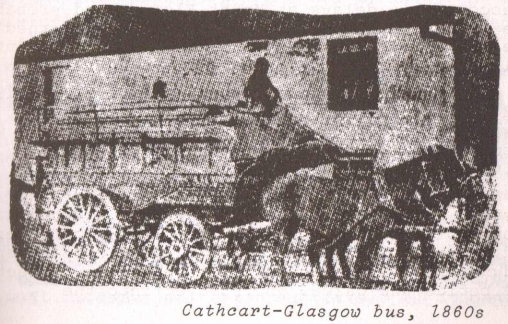
Before the advent of the railway, Peter Craig's two buses ran for many years from Gow's public house in Clarkston Road to the city from 8 a.m. until 6 p.m. on weekdays, the last homeward journey being at 7 p.m. It was said that they I were good comfortable vehicles drawn by two well-fed horses.
The Tramway and Omnibus Company ran horse and mule drawn cars, and the laying of rails in Glasgow streets began in the 1870s. The Corporation continued with horse-drawn vehicles. until the turn of the century, but Cathcart never saw this type of tram since it got no further than Mount Florida which was then the city boundary. A depot was built and Holmlea Road constructed in 1900-01 especially for the electric trams, the first of which appeared on September 13th, 1902.
For many years trams were known by their colour and number. White No. 19 trams plied between Cathcart and Springburn termini, and yellow No.5 between Kirklee and Netherlee or Clarkston. The routes diverged at Garry Street and the fares varied from ½d to 2½d. The service was second to none, and the city's farewell in 1962 will be remembered for some time to come. All models of trams are exhibited- in the excellent Transport Museum at Pollokshields.
Motorbus services started in Glasgow in 1924, followed by trolley buses ("silent death") in 1949. The wires for the latter disfigured the roads with unsightly poles and overhead wires but were soon removed in favour of the present diesel vehicles.
The "troubles of the country" are again apparent, and the city's transport department has to cope with an acute shortage of staff as well as high running costs. Some new system of public transport is clearly required, but what .....?